Hot off the Greens and Machines foundry are these stylish beverage coasters.

We are two brothers who are taking on the world through a variety of DIY projects. Topics cover Gardening, Homebrewing, Viticulture, Machining, Metalworking, Cooking, Bicycling, and more! "Excellence in every direction"
Showing posts with label Foundry. Show all posts
Showing posts with label Foundry. Show all posts
Sunday, September 4, 2022
Tuesday, April 13, 2021
Casting The Turntable Base

As much work as building the pattern for the turntable base was, this was only half the battle when it came to making it. Casting the actual base posed a whole different set of challenges. The first of which was the need to construct a flask big enough to make the sand mold. Standard turntable size is bigger than anything I'd casted, about 14.5"x18", so the flask had to be at least this big with extra room for sand all around. I decided to fabricate this monstrosity from scrap pieces of steel plate. I bought a large piece of rectangular tubing and cut it up to create the rounded corners. For the parting surfaces, I originally welded a strip of 1/4" steel on the edges, but due to problems of the steel deflecting and not aligning, I resorted to screwing small pieces of angle iron onto the strips to form a good flat edge. On top of all this trouble, the flask ended up being really really heavy. I was originally going to weld ribs all around the outside perimeter to prevent the walls from bulging out when ramming in the sand, but I either ran out of material, or figured it was already way too heavy. Even with no sand inside, it almost needs two people to lift it.

Here is the pattern in the flask ready for molding. Ideally, there would be a bigger gap between the flask and pattern walls so the sand would have more support, but I wasn't interested in making this thing even heavier.

Saturday, April 10, 2021
Building The Turntable Base Pattern
I made the turntable base from cast aluminum. Unlike the Technics 1200 which has a die cast body, I sand casted mine. This is because die casting is suited for mass production and requires a permanent mold, which is hard work (if you don't believe me, see the soap dish mold project). Actual die casting also requires really expensive equipment to hydraulically clamp the mold shut and inject the liquid metal under very high pressure. Clearly I wasn't going to go through all that trouble and expense just to make one or two turntables, thus sand casting was the natural choice. In order to cast it like this, I had to construct a pattern for making the sand mold.

First let's discuss the design of the turntable base. I chose this weird half-rectangular, half-circular shape because it seemed easier to mold than if it were a rectangle. It also required less material. I was determined to cast the base in one piece, and without the use of any sand cores (because for some reason, my foundry technology level hasn't reached that point yet). The base also had to have this big hole in the middle for a drive belt to go through. I chose belt drive since I didn't feel confident enough in my electrical skills to attempt a brushless direct drive motor like the Technics.
Now let's get into the pattern. I started this project years ago. You may remember a video of me cutting a 16" diameter piece of wood on my lathe, well this is what it was for.

Monday, April 27, 2020
Casting Coach Z's Medallion (Video)
I decided this year I wanted be Coach Z for Halloween, which finally gave me a use for all the scrap brass I'd been saving up!


Tuesday, July 23, 2019
The Foundry - First Attempted Production Run with The Molding Press - Casting Soap Dishes with The Foundry (Video)
Friday, June 14, 2019
The Foundry - Building a Permanent Molding Press (Video)
Monday, March 18, 2019
Hitting level 85 Smithing IRL | Painting the Ingots
Back when I was visiting home for winter, I managed to snag the aluminum ingots that Diecaster_D cast in his foundry. Despite being great paper weights, I thought they could use a good paint job to actually look like something out of Runescape.


Tuesday, February 5, 2019
Diecaster D.'s New Years Resolutions
Happy New Year everybody!
 Yeah I guess waiting until Lunar New Year gave me an extra month to reconsider my goals for the year, but better late than never eh?
Wednesday, June 13, 2018
Turtle Unification
This turtle sandbox I got for my foundry molding sand a few years ago has been awfully convenient. The only problem was it didn't come with the lid, so we had problems with the sand getting completely soaked whenever it rained. The blue tarp didn't help much in terms of waterproofing, so eventually we decided to keep it inside.


Tuesday, January 16, 2018
The Foundry: Melting a Honda Engine Head (Video)
One day I was riding by and found some junk on the side of the road including various parts of a Honda 4 cylinder engine. I decided to take them since I had my new upgraded bike basket which easily fit it all, and why would I pass up the single largest piece of scrap aluminum I'd ever found on the side of the road? (alright, maybe I'm not counting the time I found a car wheel next to the dumpster)
 Instead of trying to disassemble all the valves and springs on the engine head and trying to cut it up into crucible sized chunks, I decided I'd just melt it directly in the furnace and let the molten aluminum drip out the bottom into some metal trays lined with sand. What better way to kick off the foundry season then with some scrap downsizing? Here's the video of the melt in real time:

Thursday, September 21, 2017
Scrap Alchemy Prevails! New Foundry Sand Sieve
I had been planning to build a new sieve for my foundry sand, but due to unforeseen circumstances, it got delayed again. The first sieve I made was just some very thin plastic with a window screen stapled on it, but the plastic disintegrated. The 2nd one was a metal one I bought at a garage sale for $1, but the holes were too small to let sand through at any decent rate. I was planning to use some 1/4" chicken wire connected to a wooden hoop, but imagine my surprise when I found this on the side of the street 4 days later:
 |
| Hey, what's that? |
Wednesday, April 19, 2017
New Crucible and Casting Brass
I had never really gotten around to buying a "real" crucible for melting anything hotter than aluminum. The one time I made it to the foundry supply store, I forgot that they closed at 3 PM, and it was 3:15 or something.
2 Years later: I got invited to American Foundry Society/ North American Die Casting Association annual vendor's night. This is an event where people from the industry get together and showcase their products, hang out, and have a good time.Personally, I was just there for the free food. Long story short, each vendor booth had a raffle prize, and judging by the proximity of this crucible to the ticket jar, I thought it was the prize. I asked if it was because I had been in the market for one, but it turned out they were only giving away $100 cash. Still, I bet most of my tickets on them since it seemed like one of the better prizes compared with all the alcohol, golf accessories, and gift cards for restaurants that don't have enough vegan menu items... But I really wanted the crucible! At the end, I didn't win any of the drawings, but the nice people at Advanced Ceramics and Crucible decided to give me the crucible anyways! I guess when you're young and have your own foundry, people treat you differently or something (it's because in an industry like this, they're hard pressed to find young people interested in it, there's actually quite a shortage of people to replace those retiring). Hey, it worked before when I accidentally got a free lathe. This goes along with a discussion we had there was about "what got you interested casting?" Of course for me it was the concept of being able to melt and recycle your own metal, and cast seemingly unlimited parts from a single pattern, and in the case of a vegetable oil furnace, for practically free. Going back even further, it was probably the "Foundry" level from Tony Hawk's Pro Skater 3 where I first learned the word "foundry".
Anyhow, it's a silicon carbide crucible which, if I remember correctly from chemistry class, is nearly identical to diamond in its molecular structure and almost as hard, but who cares? Let's melt some metal!
2 Years later: I got invited to American Foundry Society/ North American Die Casting Association annual vendor's night. This is an event where people from the industry get together and showcase their products, hang out, and have a good time.
 |
| OSHA's gonna sue somebody |
 |
| Grapefruit for size reference |
Saturday, November 12, 2016
Melting Metal at the Beach with a Hand Cranked Foundry Blower
I finally got an opportunity to try this when I received a blower for free at a garage sale. Apparently the previous owners had their house heater replaced, and the workers didn't want to throw out a perfectly good blower.
At first, I had the impression that the original housing would be to flimsy to bolt the required hardware to, so I decided to build a new one.

Friday, June 10, 2016
California Persimmon Progress: June
Like I mentioned in the Grapefruit post, Persimmon trees bear fruit in the autumn, and as it just so happens at Foundry Academy, the plant tours aren't only industrial in nature. We actually have an agricultural college with Oranges, Squash, Grapefruits, Grapes, Avocados, Kale, Yellow Watermelons, and just about anything else you can grow here (which is pretty much everything). AND there's a farm store where you can buy our produce and support the program. With that being said, let's check out our friend Mr. Fuyu (which I'm pretty sure is Sebulba's final line in Star Wars Episode 1 because he has an orange colored pod racer)
Foundry Academy: "The Place To Be For A Quality Metal Casting Education"

 |
| Stay squashy my friends |

Thursday, March 24, 2016
The Foundry - Aku Aku and the Soap Dish
So as I mentioned in my first post, I was working on a hood ornament for my bicycle shaped like Aku Aku from Crash Bandicoot.
 I decided to make the pattern out of oven bake clay.


Monday, June 15, 2015
The Foundry - "Some Call it Ankh is a key"

 |
| The Statue |
Friday, April 3, 2015
The Foundry: Molding Sand
Let's see what we got in the trailer today... Oh it looks like we're making some molding sand for the foundry! Now that we got the furnace working at a decent level, it's time for some real casting action!
For over a week I was compulsively checking the free section on Craigslist hoping for a free bathtub which I was going to store the sand in, but the Scrap Alchemists had something better in mind. Instead of letting me have a bathtub, they intentionally withheld all free bathtubs in the area for those two weeks until I could find this: the turtle sandbox. I know this for a fact because as soon as I got the sandbox, free bathtubs started appearing all over the place. With that notion, I decided that bathtub dodging was very necessary. Not in a gypsy sort of way. Actually, yes.
Anyways, we gave the turtle a lift by attaching some trashpicked castors onto a pallet. There were a few small holes in the bottom of the sandbox, but I just put duct tape over them.

 |
| Details on the trailer now available! |
Anyways, we gave the turtle a lift by attaching some trashpicked castors onto a pallet. There were a few small holes in the bottom of the sandbox, but I just put duct tape over them.
Sunday, February 15, 2015
The Foundry: Oil Tank Redemption and Controlled Burn
After the tragic outcome of the previous foundry session, a few things needed to be fixed before we could fire it up again.
Act 1 - New Wheels
Since the original furnace wheels got lit and completely melted, we decided it would be wise to make new ones out of steel. We couldn't just let the furnace sit there without wheels either because it would cause a height difference between the blower and the furnace inlet. I went to work turning the new wheels out of some 3" scrap.
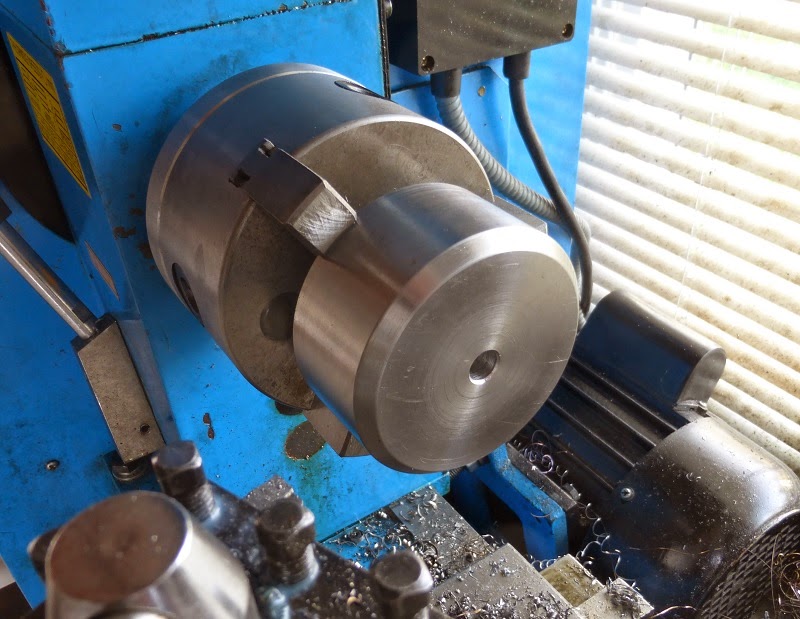
Act 1 - New Wheels
Since the original furnace wheels got lit and completely melted, we decided it would be wise to make new ones out of steel. We couldn't just let the furnace sit there without wheels either because it would cause a height difference between the blower and the furnace inlet. I went to work turning the new wheels out of some 3" scrap.
Sunday, February 1, 2015
The Foundry: Testing Everything and Pressure Tank Disaster
Alright no more messing around, time to fire up the foundry for real this time with the new burner, new oil tank, and blower.
First filtering the oil with a metal screen and funnel I made from a coffee can with a pipe floor flange bolted on the bottom. This just screws onto the pipe welded on the tank for minimum leakage. I say minimum because it still leaked, which is why the towel is there.
 Reconfiguring the burner with the new needle valve.
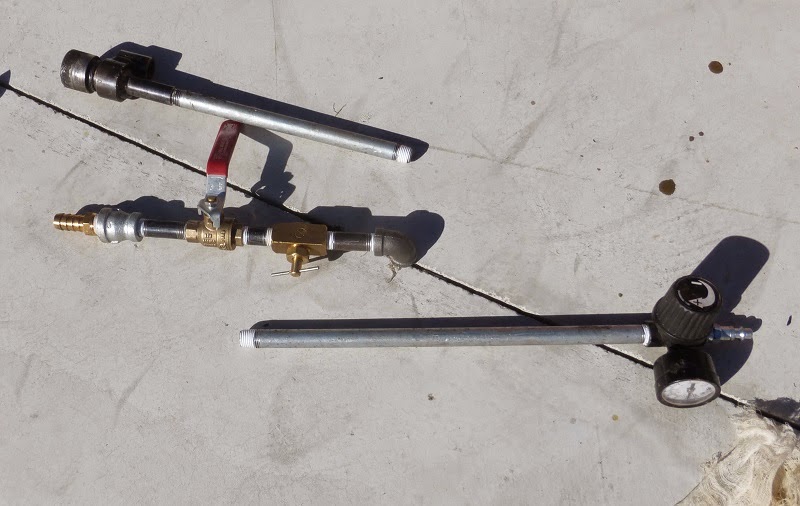
First filtering the oil with a metal screen and funnel I made from a coffee can with a pipe floor flange bolted on the bottom. This just screws onto the pipe welded on the tank for minimum leakage. I say minimum because it still leaked, which is why the towel is there.
Sunday, January 25, 2015
The Foundry: It's Time To Build A New Oil Tank
The new burner has proven success with the garden sprayer pressurizing the oil. The next step was to build a new tank that holds more than one gallon, so there would be enough fuel to actually complete a decent melt without stopping to refill.
