

We are two brothers who are taking on the world through a variety of DIY projects. Topics cover Gardening, Homebrewing, Viticulture, Machining, Metalworking, Cooking, Bicycling, and more! "Excellence in every direction"
Wednesday, April 30, 2014
White Lisbon Onion

Sunday, April 27, 2014
Brew Day #8: "Burning Bear" Amber Ale + Recipe
 |
| No bears were immolated in the creation of this brew |
Saturday, April 26, 2014
Tap Handle (Brewing)
When my brother told me to make him a tap handle I was wondering what he needed a tap handle for if he had not any taps? Unbeknownst to me, the term tap handle also refers to the lever shaped thing you pull to dispense alcohol at a bar. Since I had some leftover baseball bat from the hammer handle project, I decided to have some fun and try freehand wood turning.
First, I drilled and tapped a 3/8"-16 hole in the end of the wood piece. I believe this is the standard thread for tap handles.
 I used a piece of 3/8"-16 threaded rod to hold it in the lathe.
 All set up before turning.

First, I drilled and tapped a 3/8"-16 hole in the end of the wood piece. I believe this is the standard thread for tap handles.
Thursday, April 24, 2014
More Cabbage, More Food -- Garden Update April 24
 |
| Surviving the heat, and soaking up sun. |
Saturday, April 19, 2014
Time To Learn Excel
The Premise:
All "normal" milling machines have table feed hand wheels that move the table .200" per revolution. This makes calculating the distance to be moved easy because it is a nice round number. For example if you wanted to move the table 1.878" it would be 9 revolutions plus .078" on the dial.
This is not the case with my Knuth DBF 400 as the hand wheel moves the table .166" per revolution. Where they got this number from I have no idea, though it probably has something to do with the feeds and gearing for cutting threads. Interestingly enough, the cross feed hand wheel moves the table .100" in the Y axis which is much easier to work with.
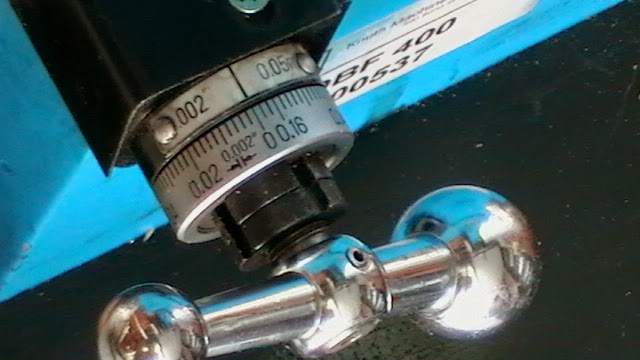 Let's say we want to move the table 1.878", we would have to divide 1.878" by .166" then rotate the hand wheel by the answer and any remainder on the dial. Thus I take out the calculator and input 1.878/.166 which gives 11.313253012048192771084337349398 which tells me there will be 11 full revolutions, then plug in 1.878-11(.166) to get the remainder.
Instead of doing all these calculations every time I want to move the table any distance over .166", I figured it would be handy to make a chart that shows the amount of distance moved in relation to number of revolutions of the hand wheel. Therefore, the calculation would me much faster.
Option 1:
Draw a chart by inputting the numbers into the calculator one at a time........ very slow. Upon attempting this, it occurred to me why they invented computers; to do the math for you.

All "normal" milling machines have table feed hand wheels that move the table .200" per revolution. This makes calculating the distance to be moved easy because it is a nice round number. For example if you wanted to move the table 1.878" it would be 9 revolutions plus .078" on the dial.
This is not the case with my Knuth DBF 400 as the hand wheel moves the table .166" per revolution. Where they got this number from I have no idea, though it probably has something to do with the feeds and gearing for cutting threads. Interestingly enough, the cross feed hand wheel moves the table .100" in the Y axis which is much easier to work with.
Instead of doing all these calculations every time I want to move the table any distance over .166", I figured it would be handy to make a chart that shows the amount of distance moved in relation to number of revolutions of the hand wheel. Therefore, the calculation would me much faster.
Option 1:
Draw a chart by inputting the numbers into the calculator one at a time........ very slow. Upon attempting this, it occurred to me why they invented computers; to do the math for you.